Brand Partners
Well-known consumer labels alongside premium private-label options, in men’s and women’s fits, so your apparel program can cover every role at a price point that works.
35 brands
Consumer names alongside premium private label.
Men's and women's fits
On every item in the portfolio.
One store for every label
Built to your branding guidelines.
One contact
For every brand in your store.
Why the Portfolio Matters More Than the Brand
Most apparel program conversations start with a brand name. They should start with a roster.
A company outfitting an executive team, a sales force, an office staff and a field crew does not need one label. It needs a portfolio that covers four quite different sets of requirements at three or four price points, in fits that actually suit the people wearing them, with one consistent logo application across all of it.
That is the work. Choosing which brands sit inside that portfolio is the last step, not the first. What we bring to it is the range to build it properly, and the experience to tell you when a label your business likes is the wrong choice for a particular role.
That is the balance a portfolio has to strike. Broad enough to supply every role in a company of any size, and specific enough that the people in each of those roles get something they will actually reach for.
What We Build Portfolios From
The first decision is recognition against reach. The rest follows from it.
Recognition
Consumer brands
Names like Nike, Adidas, The North Face and Carhartt that your employees already know and choose to wear outside work. Recognition drives adoption, which is what makes a program worth running. They cost more per unit, and for client-facing and executive roles they are usually worth it.
Reach
Premium private label
Comparable construction and finish without the consumer brand premium. The only logo on the chest is yours, and that is the one you are paying to show off. For programs covering several hundred employees this is where budget goes further, and in practice most people cannot tell the difference once your mark is on it.
Both tiers extend into
Workwear and industrial
Durable work shirts, flame-resistant garments and outerwear built for field, production and trade environments, held to the same branding standard as everything in the office tier.
Headwear, bags and event gear
Embroidered caps, computer and travel bags, and the gear that trade shows, golf outings and company events need, drawn from the same approved portfolio rather than sourced separately each time.
Categories Your Program Can Cover
One portfolio, built to cover every role in the business.
01
Office and client-facing
Dress shirts, polos, knits, sweaters and soft-shell layers for staff who represent the business in front of customers.
02
General employee
Everyday polos, tees and fleece at a price point that works when the program covers the whole headcount.
03
Field and production
Industrial work shirts, flame-resistant workwear, high-visibility items and heavy outerwear.
04
Outerwear
Jackets, vests and shells across weights, which is where most programs find their recognition and awards spend.
05
Headwear
Structured and unstructured caps, beanies and visors, embroidered from approved files, including a cap version of your logo where one is needed.
06
Bags and accessories
Computer bags, duffels, totes and travel gear for onboarding kits, events and recognition programs.
Fit Is a Program Decision, Not a Detail
When half a workforce is offered a garment cut for the other half, they do not complain. They just stop wearing it, and the branded apparel your business paid for sits in a drawer. Adoption is the only measure of an apparel program that matters, and fit is the biggest lever on it.
The same logic applies to sizing range. A portfolio that runs out at the edges excludes people by accident, so we build one that does not.
Men's and women's fits on every item
Every item we put in a portfolio is available in men’s and women’s fits. That sounds administrative and it is the single most common reason internal apparel programs fail quietly.
One Standard Across Every Label
Mixing brands inside a single program creates an obvious risk: your logo starts looking slightly different depending on what it is sitting on.
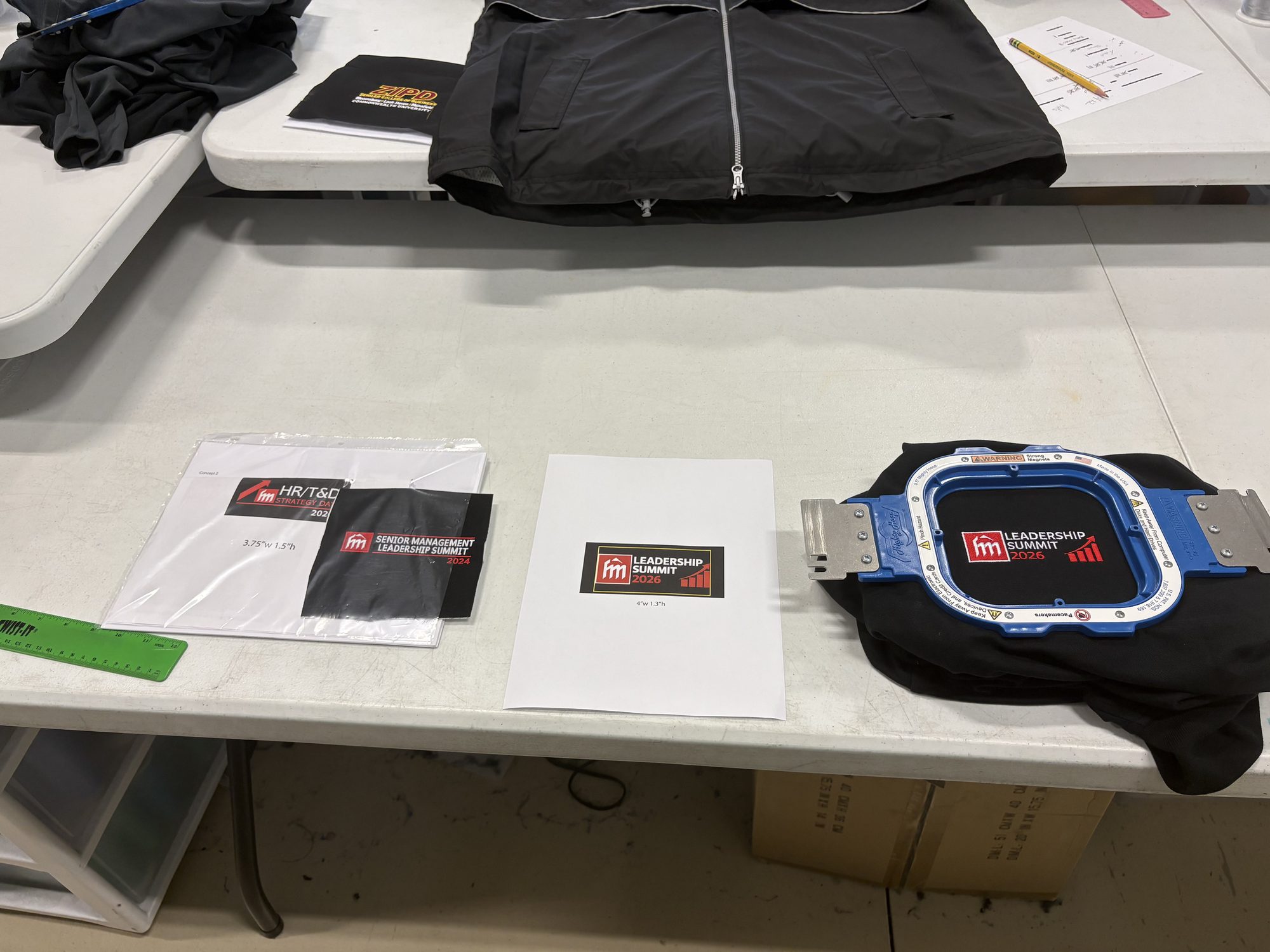
That does not happen here because decoration is in house. Your logos are digitized into embroidery stitch files, and screen printing files are prepared alongside them. Every garment in the portfolio, whatever the label on the inside, carries the same mark in the same colors in the same position. Brand consistency stops being something anyone has to police and becomes a property of how the program is built.
It also means we can tell you before you commit when a particular fabric or color will not hold your mark well. That conversation is much cheaper before the portfolio is approved than after three hundred garments have shipped.
How the Portfolio Gets Built
On the discovery call we go through your roles, your locations, your branding guidelines and your budget. We come back with a recommended portfolio, you approve it, and it becomes the only thing your employees can order. No off-brand items, no exceptions to manage, no one-off purchase requests to approve.
Corporate Apparel From the Brands We Carry
Which of these end up in your portfolio depends on your roles, your branding guidelines and your budget.
Consumer brands
If someone already owns a brand, they will wear it to work without being asked. That is the practical case for putting consumer brands in a company apparel program instead of defaulting to the cheapest blank. For client-facing, office and executive staff, Vineyard Vines, Brooks Brothers, TravisMathew, Tommy Bahama, Eddie Bauer, Callaway, Original Penguin and Puma Golf sit at the top of the range. Nike corporate apparel, Adidas and Under Armour give you performance polos and layering that hold their shape through a long day. The North Face corporate apparel, Columbia, Marmot and Spyder handle outerwear across weights, which is where most programs find their recognition spend, and OGIO and MIIR cover bags, travel gear and drinkware for onboarding kits and gifts. For field and production roles, Carhartt corporate apparel and Red Kap work shirts lead, with Bulwark where flame resistance is required, Dickies for work pants and Kishigo for high visibility. We are always searching out new brands and premium private label products that bring value to the companies we work with.
Vineyard Vines
Brooks Brothers
TravisMathew
Tommy Bahama
Eddie Bauer
Callaway
Original Penguin
Puma Golf
Nike
Adidas
Under Armour
The North Face
Columbia
Marmot
Spyder
Cotopaxi
New Era
OGIO
MIIR
Champion
Swannies
HUK
Dri Duck
Richardson
Bella + Canvas
Comfort Colors
Carhartt
Red Kap
Bulwark
Dickies
Kishigo
Premium private label
The same program usually runs a second tier alongside the first. Sport-Tek, Port Authority, CornerStone, District, Devon & Jones and Mercer + Mettle give you comparable construction and finish without the consumer brand premium, so the logo on the chest is yours and the program stays affordable when it covers four hundred people rather than forty. Charles River handles outerwear and rainwear, and Holloway, Badger and Alleson cover performance and team-style pieces. Most portfolios mix both tiers by role rather than picking one and living with it.
Sport-Tek
Mercer + Mettle
District
Port Authority
CornerStone
Devon & Jones
Charles River
Holloway
Badger
Alleson
Decoration covers embroidery on polos, woven and dress shirts, quarter-zip and full-zip layering, coats and rainwear, caps and knit hats, messenger, computer, fitness, travel and worksite bags, soft-sided coolers and workwear including bibs. Screen printing covers performance fabric shirts and sweatshirts, cotton tees and sweatshirts, safety vests and fitness pants. For program customers we also handle projects outside the norm, such as custom knitted socks and scarves for gifting programs.
Brands Available
Most of the brands we carry come through our two main suppliers, SanMar and S&S Activewear. You never have to browse a catalog to get a program built, because we put the portfolio together for you. If you would like to see what is out there first, both suppliers have unpriced catalogs you can look through, and anything that catches your eye is worth mentioning on the call.
Why Buy Name Brands Through a Program
Several of the brands we carry, Carhartt and Vineyard Vines among them, sell logo apparel to businesses through their own corporate programs, and catalog sites list The North Face, Nike and Columbia with your logo added. Those are good routes for a single order from a single brand. They are a harder fit for an employee apparel program, where one company needs several brands, several groups of employees and one consistent look.
Buying through each brand's own program
- One relationship per label
- Logos applied differently by each supplier
- A separate order for every brand
Every brand in one company store
- Every brand in one private store
- Your logos applied the same way on every label
- One contact for every brand
A program puts every brand in one private online company store built to your branding guidelines. Your approved logos are applied the same way on a Carhartt jacket, a Nike polo and a private-label quarter-zip, so nothing drifts from one label to the next. Employees order their own sizes across all of those brands in one place, funded by employee apparel credits, and each order is decorated in our building and shipped to them within 5 to 7 business days.
You also deal with one contact for every brand in the store, rather than one relationship per label. That is the difference between buying branded apparel and running a corporate apparel management program.
Where This Fits
The managed program the portfolio sits inside.
How balances are spent against the portfolio.
Common Questions
Usually. Tell us on the discovery call which labels your business already standardizes on and we will tell you honestly whether we can source them and at what point it stops making sense.
Yes, across the portfolio rather than as an afterthought on a handful of items. A program that only fits half a workforce is a program people work around.
Consumer brands carry recognition and a price that reflects it. Private label gives you comparable construction without the consumer brand premium, so the only logo on the chest is yours, which matters when a program covers hundreds of people. Most portfolios mix both by role.
Yes. A common setup is a premium tier for client-facing and executive staff, a standard tier for general employees, and workwear for field and production roles, all in the same store.
Your business does. We build against your branding guidelines and recommend based on roles and budget, but nothing is offered to your employees without your approval.
Yes. Items get added, retired and swapped as roles, seasons and headcount change. The store is built to be adjusted rather than frozen at launch.
Yes. Industrial work shirts, flame-resistant workwear and outerwear sit alongside dress shirts, polos and knits, which is what most organizations with both office and field staff need.
You can lead with one, and most programs do not stay there. A single label rarely covers an executive polo, a general-employee tee and a flame-resistant work shirt at three sensible price points, so what usually happens is that one brand anchors the program and two or three others fill the roles it does not reach. Tell us on the discovery call which label your business already standardizes on and we will build out from there.
Yes, along with The North Face, Carhartt, Columbia, Eddie Bauer, Vineyard Vines, OGIO, Red Kap and the rest of the list above. Which of them end up in your store depends on your roles, your branding guidelines and what you want the program to cost per employee, not on what we happen to have on a shelf. Nothing is stocked ahead of an order.
Sizing, fits and which labels suit which roles come up constantly, so those answers live on the apparel program FAQ alongside the rest.
Talk Through Your Portfolio
Tell us your company name, roughly how many employees you have, and what roles need covering. Our team will follow up to set up a call.