
Corporate Apparel for Manufacturing and Industrial Companies
Multiple facilities, more than one logo, a production floor and an office that need to look like the same company, and a project coordinator who did not ask to own the apparel. This is the work we have done longest and the sector most of our programs belong to.
Built for multi-site plants
One store across every facility, office and logo.
Workwear labels for the floor
Industrial labels alongside the consumer names.
Purchase, not rental
Your people own what they order. No route, no contract.
Ships to each employee
Packed individually and tracked to their door.
You Are Probably Comparing This to a Rental Program
Most manufacturers who call us are weighing a managed program against a uniform rental service, and that is the comparison worth making first, because the two models behave nothing alike once you are a year in.
A service contract with clothing attached
- A recurring service fee
- The garments belong to the supplier
- Collected, laundered and returned on a route
- Typically a multi-year agreement
- Per-garment charges that move
Apparel your workforce owns
- People order what they need
- It is made for them and shipped to them
- The apparel is theirs to keep
- Nothing to collect back and nothing to audit
- No weekly route and no agreement to exit
For some operations rental is genuinely the right answer, particularly where garments need industrial laundering for contamination reasons. We lay out both models side by side, including when rental is the better choice, on our uniform rental vs purchase page, and the managed employee uniform program page sets out the purchase model in full.
Three Groups, One Brand
This is where industrial programs differ from almost every other sector. A bank is clothing one kind of person. A manufacturer is clothing three, they work in different conditions, and the apparel still has to read as one company to anyone who walks through the door.
01
The production floor
Workwear shirts, jackets and bibs built to survive the environment and a long wash cycle. Work pants are usually left undecorated, because a logo at the knee earns nothing and wears out first. Safety vests are standard and screen printed.
02
Office and client-facing
Polos, woven and dress shirts, quarter-zip layering and outerwear. Same marks, same colors, different garments entirely. This is the group most likely to notice if the portfolio was assembled rather than chosen.
03
Field service and sales
The people who turn up at a customer site and are the company for that afternoon. Outerwear, caps and bags matter more here, and so does the decoration holding its appearance after a season on the road.
One store carries all three, with eligibility set per group so a floor supervisor and a regional sales manager see different items when they log in. Nobody is browsing apparel that was never meant for them.
Companies whose crews work at customer properties rather than on their own site have a different version of this again, covered on restoration crew uniforms and branded workwear.
What the Portfolio Covers on an Industrial Site
The brands are chosen for the work rather than for the catalog. Workwear and industrial labels sit alongside the consumer names an office expects, so a maintenance technician and a plant manager can be visibly the same company while wearing completely different garments.
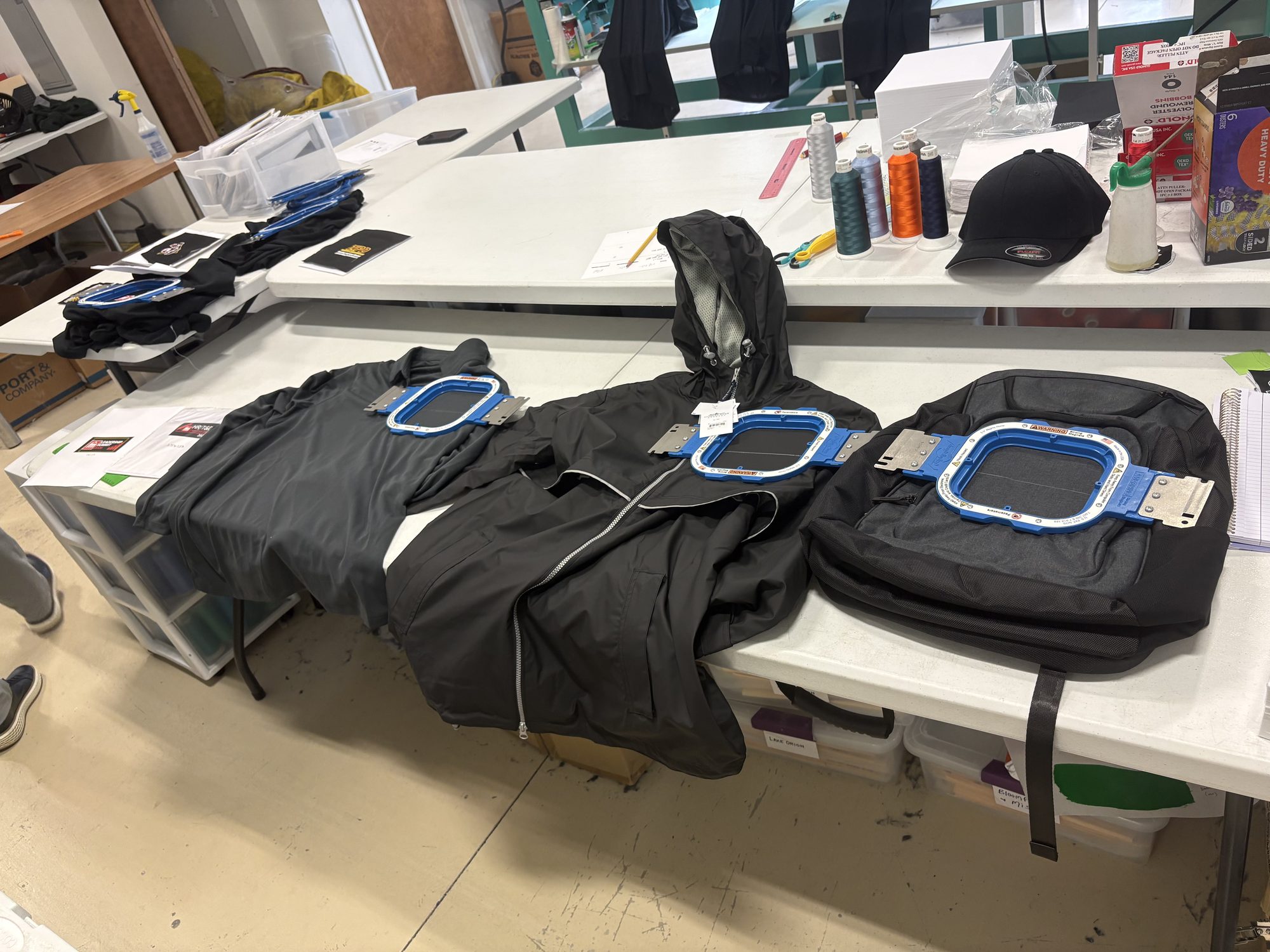
Workwear and industrial labels in the portfolio include Red Kap, Bulwark, Dickies, Carhartt, Dri Duck and Kishigo, with the broader consumer and performance range covered on the brands we carry. Embroidery covers polos, woven and dress shirts, layering, coats and rainwear, caps, bags and workwear shirts, jackets and bibs. Screen printing covers performance and cotton tees and sweatshirts, safety vests and fitness pants.
One thing we will not do is guess on protective specifications. If a role needs a garment with a specific flame resistant or high visibility rating, raise it on the call and we will tell you honestly what we can and cannot source rather than selling you something and sorting it out afterwards.
Multiple Sites, and More Than One Logo
Almost every manufacturer we work with past a certain size carries more than one mark. A corporate identity, a divisional one, something inherited from an acquisition that nobody has retired yet, and occasionally a plant that has quietly developed its own.
Every logo proven out
Every mark is turned into its own stitch file and approved on a sewn sample. Assigned to the right items, so a Michigan plant and a Texas division never end up with each other’s logo by accident.
No site holds stock
Every order is produced after it is placed and ships to the individual. No plant keeps a supply cupboard, and no site administrator becomes the person who hands out shirts.
One standard across every facility
Thread and ink colors come from your branding guidelines rather than from whatever the nearest supplier had. A site you visit twice a year looks like the one down the hall.
All of the decoration happens in our own building, which is the practical reason that standard holds across sites and across years. The detail is on logo digitizing, embroidery and screen printing.
Distribution is the part that disappears. In a bulk model somebody at each site is unpacking, sorting and handing out, which is unbudgeted work nobody was hired to do. Here the distribution step does not exist, and the professional appearance the program is supposed to deliver stops depending on whether a site administrator had time this week.
Durability, Comfort and What Survives a Year on the Floor
The question a plant manager asks that a marketing buyer never does: what does this look like after a hundred washes. It is the right question, because an apparel program is judged on the garments people are still wearing in month eleven, not on the ones that looked good at launch.
The right garment
Industrial and workwear labels are built for the work. A lighter garment shows up as a replacement cycle twice as fast.
Decoration matched to it
Embroidery on workwear shirts and jackets, printing on tees and safety vests.
Comfort people will wear
People do not wear what is uncomfortable, and a program nobody wears has failed.
Fits and layering
Men’s and women’s fits, plus layers to adjust across a shift and the seasons.
Because nothing is produced before it is ordered, changing a specification does not mean writing off inventory. If a work shirt is not holding up, the portfolio changes and the next order is the new one. That flexibility is worth more over a few years than any single garment choice.
Shift Turnover, New Hires and Replacements
Industrial headcount moves, and that is where a bulk ordering habit does the most damage. Order once a year and every person hired in the eleven months afterwards is either in nothing or in whatever was left over in the wrong size.
Because production starts when the order is placed, a single person ordering a single work shirt is a normal order at the same price as a large one. A new hire on their first week is in company apparel before they have met everyone. A work jacket that has had three winters gets replaced quietly rather than being worn until it is embarrassing.
Orders ship within 5 to 7 business days. How the replacements get funded is a policy question rather than a supply one, and the employee dress code and apparel policy page covers how to settle it in advance so a supervisor is not making the call garment by garment.
Size, Spend and What It Costs to Start
employees at most of our manufacturing clients
to build the store
average spend per employee per year
items on a typical order
Most programs set a floor of at least $100 per employee per year with the average landing at $200 or more, and a typical order runs to about four items. Billing is redemption based, so you are invoiced against what people actually order rather than against the full credit pool.
The one thing that sinks a program
The one thing that reliably sinks an industrial program is launching it with no company funding at all. Participation stays low, the floor concludes it was never really for them, and the program gets written off for reasons that have nothing to do with the apparel. Some level of subsidy is what makes the rest of it work.
Manufacturing Sectors We Work With
Engineering, build floor, field service and trade show teams in one store.
Branded apparel for engineers and global field service outside the cleanroom.
Machining, molding, quality and shipping across multiple plants.
Workwear, hi-vis and outerwear for yards, mills and field crews.
How a Manufacturing Program Gets Started
Discovery call
A Zoom call, usually about an hour, about your sites, roles and logos.
Store built
We build the portfolio to your branding guidelines and you approve it.
Logos sewn out
Every logo is digitized, sewn out in house and photographed for approval.
Store goes live
Employees order their own items and their own sizes.
Ships to each person
Within 5 to 7 business days, to their door.
See every step on our process page.
Where This Fits
The other sectors we run programs for, and what changes between them.
The purchase model in full, set against uniform rental.
How individual orders reach people across multiple sites.
The full managed program this sits inside.
Common Questions
Rental is a recurring service contract where the garments belong to the supplier and come back on a route to be laundered. This is a purchase model: your people order what they need, it is made for them, and it is theirs. Nothing is collected, nothing is audited, and there is no agreement to exit.
The portfolio includes workwear and industrial labels, and safety vests are a standard screen printed item. Anything carrying a specific protective rating should be raised directly on the call so we can tell you honestly what we can and cannot source, rather than guessing on a specification that matters.
Yes, and it should. Eligibility is set per group, so each person sees the items meant for their role when they log in. The marks and colors stay identical across all of them, which is what makes a site look like one company rather than three departments.
Each is digitized into its own stitch file and assigned to the right items in the store, so the wrong mark does not reach the wrong group. Most manufacturers past a certain size have more than one, often including something inherited from an acquisition.
No. Nothing is produced until somebody orders it, and each order ships to the individual who placed it. No plant holds stock, which also means no site administrator ends up distributing shirts.
Orders ship within 5 to 7 business days of being placed, and a single item for a single person is a normal order. There is no waiting for a batch to accumulate or for the next annual run.
Mostly between 150 and 1,000 employees, with the majority above 400. Companies under 50 are typically not a good fit, because below that a store tends to go unused.
Usually not. A logo at the knee earns nothing and is the first thing to wear out. Work pants are normally supplied undecorated while the shirts, jackets and bibs carry the mark.
There is no minimum on individual orders. Once your program is running, one employee can order a single polo and a tee, and it is processed like any other order. There is no contract and no leftover stock to buy back. Programs are built for steady, ongoing business rather than one-time orders, so if spending ends up well below what was planned, we talk it through with you.
Yes. Semiconductor equipment, robotics and automation, plastics shapes and components, lumber and forestry, and contract testing facilities are all sectors we currently run programs for. Steel service centers and fabrication are a logical fit we are actively interested in.
More on how a program runs on the full FAQ page.
Tell Us What You Make
Your company name, roughly how many employees you have, how many sites, and what your people do. Our team will follow up to talk it through.