
Online Company Stores
A branded storefront built for your organization, carrying only the apparel you have approved. Your employees order their own sizes directly, and every order ships to them. No spreadsheets, no collecting sizes, no off-brand surprises.
Only what you approved
Your store carries your approved portfolio and nothing else.
Employees pick their own size
No collecting sizes, no spreadsheets.
Ships to each person
Within 5 to 7 business days, packed individually.
No contract, no inventory
Make to order, with no minimum on individual orders.
What an Online Company Store Actually Does
Most businesses do not lose time choosing apparel. They lose it in the ordering process around it. Someone has to gather sizes, chase the people who did not reply, assemble a single order, and then hand things out when the shipment lands. Every cycle repeats that work from the beginning.
Ordering apparel without a store
- Gather sizes from everyone
- Chase the people who did not reply
- Place one combined order
- Hand things out when the shipment lands
- Start over again next time
Ordering through your company store
- Your approved portfolio in one place, permanently
- Employees choose an item and their own size
- Every order ships to the person who placed it
- Open all year, for new hires and events alike
- Brand colors and decoration stay consistent
A company store removes the cycle. Your approved portfolio sits in one place, permanently. Employees go there, choose an item and their own size, and order. The store does not close between events, so a new hire in March and a trade show in September use exactly the same route.
It also settles the brand question. Because the store contains only what your organization has approved, brand colors and decoration stay consistent without anyone policing it. Off-brand ordering is not a rule people have to follow, it is simply not an option that exists.
What the store carries, who can order from it and how much they can spend all come from your own employee dress code and apparel policy, which is worth settling before the portfolio is built.
What Your Store Includes
Your approved portfolio only
Shirts and polos, jackets and outerwear, headwear and bags, chosen for your brand rather than pulled from an open catalog. Well known consumer apparel brands or premium private label, in both men’s and women’s fits.
Your branding, applied consistently
Your logos are digitized and proven out, then embroidery and screen printing are both done in house, so colors and decoration reproduce the same way on every order.
Individual ordering and sizing
Each person selects their own size. Nobody internally collects sizes, guesses a distribution, or ends up holding the wrong ones.
Direct fulfillment
Each order is produced after it is placed, packaged individually and shipped to that employee, nationwide and worldwide.
Built on Shopify, Branded to You
Your store is a Shopify storefront built for your business. It carries your name and your branding, and it behaves the way people already expect an online store to behave, which matters more than it sounds. Nobody needs training to use it, and nobody sends anyone an email asking how to place an order.
What makes it different from an open catalog is what sits inside it. The products in the store are the ones your business approved, in the fits and sizes you selected, with your logo applied the way you signed off. An employee cannot find an off-brand item in the store because there is not one in it. That is the whole mechanism behind brand consistency here: it is a property of the store rather than a rule somebody has to enforce.
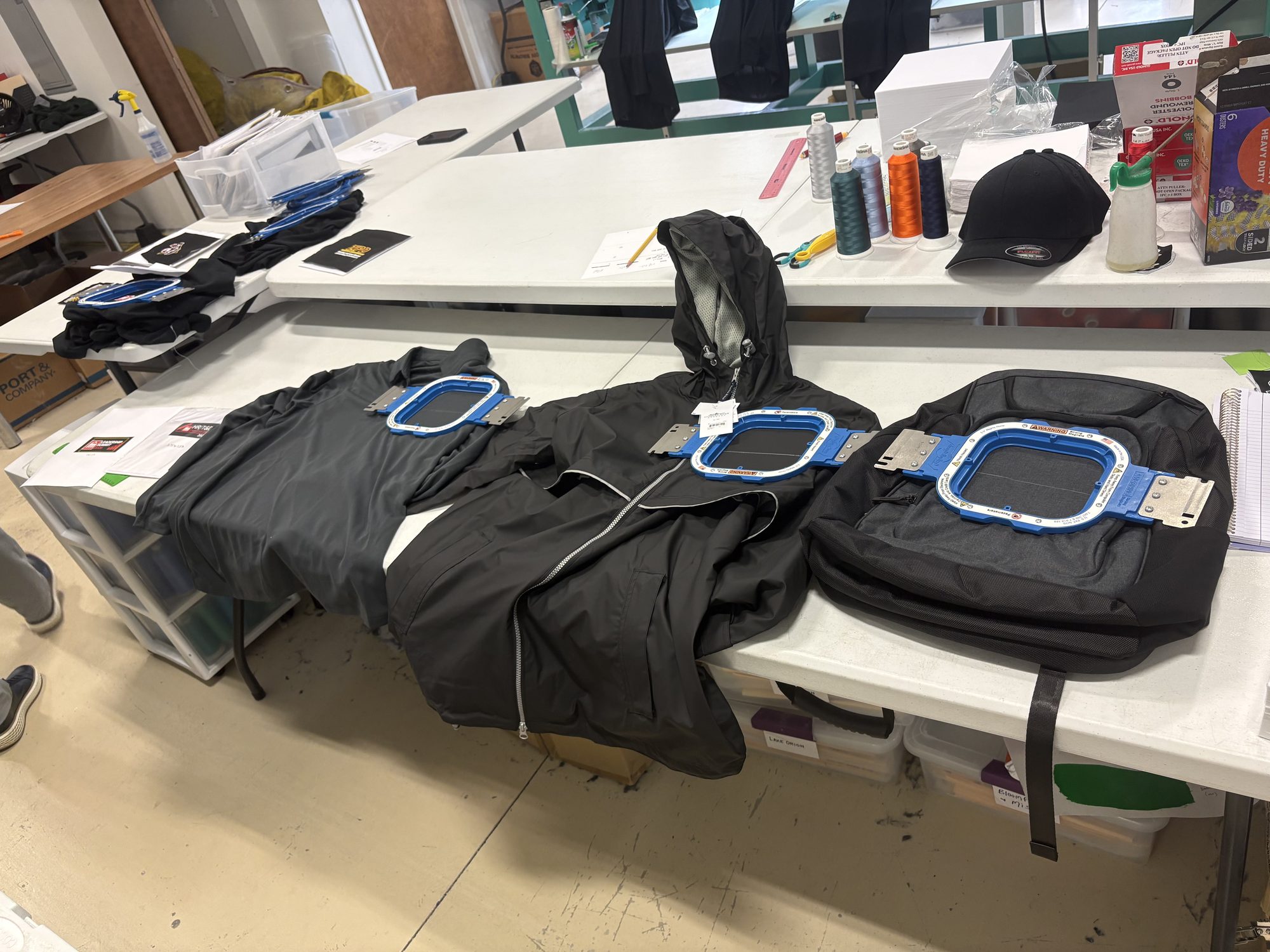
The merchandise itself covers the categories a real program needs. Polos, woven and dress shirts, quarter-zip and full-zip layering, coats and rainwear, baseball and knit caps, messenger, computer, travel and worksite bags, and workwear including shirts, jackets and bibs. Each item is decorated by the method that suits the garment: embroidery across most office and outerwear pieces, screen printing on performance and cotton tees, sweatshirts and safety vests.
If your program uses employee credits or gift balances, those are set up in the store at launch, so the balance and the catalog sit in one place rather than in two systems that have to agree with each other.
How a Store Gets Built
1
We talk
A Zoom call, usually about an hour, to understand your business, your roles and locations, and who will be ordering.
2
Portfolio
We build the selection your store will carry from your brand book, your on-brand colors and any brands or items you want. You review and approve it.
3
Digitizing
Each logo is digitized, sewn out in house and photographed for your approval. Every approved version is kept on record so future orders match.
4
Launch
Your store goes live, usually within 2 to 4 weeks of the first call, and your employees start ordering directly.
Who Uses the Store, and When
Company stores earn their keep in the moments that would otherwise each become a small project. Onboarding is the clearest one: a new employee can have a credit waiting on their first day and order their own apparel, without anybody assembling a welcome package in advance. For program clients who want a welcome package, we offer onboarding kitting as well.
Onboarding new hires
A credit can be waiting on day one, so nobody assembles a welcome package in advance.
Golf and trade events
The headcount can move until the last week without anyone reordering.
Incentives and recognition
Apparel becomes the reward, chosen by the person who earned it.
Everyday replacement
When something wears out, the employee simply orders it again.
Distributed teams
Multi-site businesses benefit most, with no central delivery point needed.
Seasonal and event items
Add an item for a season or a single event, then take it out afterwards.
For the person who owns the program internally, usually in marketing, human resources or executive administration, the practical change is that apparel stops generating inbound questions. People who need something go to the store.
The store is not fixed at launch either. The portfolio can be widened or narrowed as roles change, items can be added for a season or a single event and taken out afterwards, and a rebrand is handled by digitizing the new mark once rather than by reprinting anything. What does not change is the approval step. Anything new is in the store because your business put it there.
Onboarding Kits and Production for Any Order Size
Onboarding kitting. For program clients who want it, we assemble onboarding kits: a set of approved items, decorated, packed together and shipped to each new hire. Kitting is offered as part of a managed program rather than on its own, and it often grows naturally out of a store that is already running.
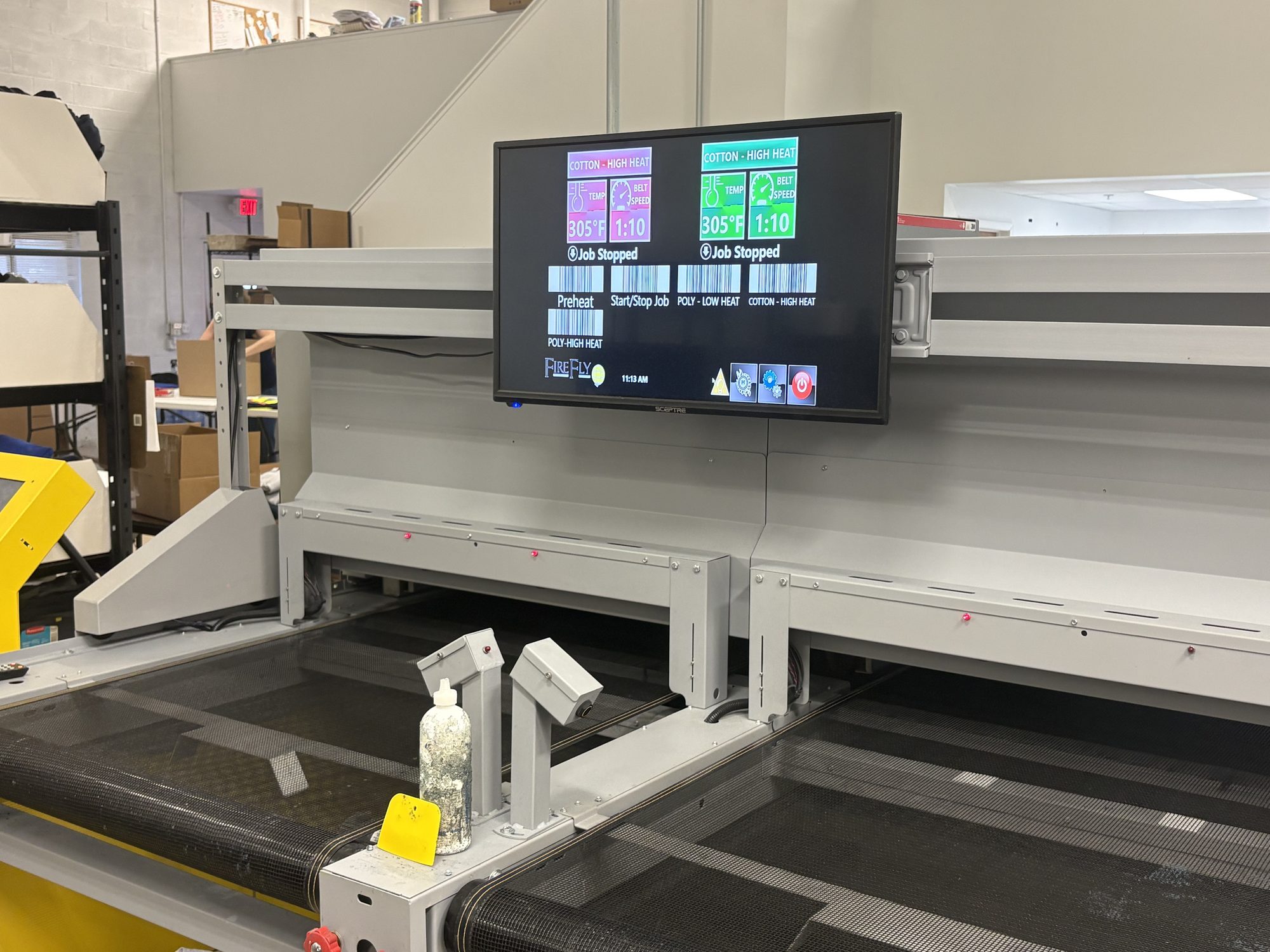
Automatic and manual screen printing. We run both. Our automatic presses handle volume, and in a single recent week we ran a 1,500 piece job and a 500 piece job. Our manual presses are what make a company store work day to day: they let us turn around small mixed orders quickly, such as one employee ordering two tees, a sweatshirt, two polos and a quarter zip, which most store-based competitors cannot do economically because of the setup cost on each screen printed item.
Embroidery runs in house on Tajima machines, so the same shop handles a single polo and a company-wide rollout to the same standard.
No Contracts, No Minimums, No Inventory
No contracts
Nothing to sign and nothing to exit.
No minimums
No minimum on individual orders inside your program.
No inventory
Nothing is made until an employee orders it.
The store is make to order. Nothing is produced until an employee orders it, so there is no stock behind the storefront, no contract, and no leftover inventory for your business to store or write off. There is no minimum on individual orders inside your program, and the store scales with your headcount instead of against it.
What to Expect Once It Is Live
Orders ship within 5 to 7 business days of being placed. That window covers the whole sequence: the blank is ordered from our wholesaler, decorated in house, packed on its own and shipped to the person who ordered it. Nothing is produced in advance, so the store holds no stock and your business is never asked to hold any either.
Order placed
An automated receipt with an order number goes out at checkout.
Decorated in house
The blank comes from our wholesaler and is decorated in our shop.
Packed and shipped
Packed on its own, with an automated tracking notice.
Delivered
Delivery notifications follow it to the employee’s door.
If something is wrong, the employee contacts us directly rather than going through whoever owns the program internally.
On spend, programs start at about $100 per employee per year and average $200 or more, with no minimum order size and no contract underneath it. Company stores make sense at roughly 100 employees and up, which is the point where apparel stops being an occasional purchase and becomes a recurring obligation somebody has inherited.
Settle this before launch
One thing worth settling before launch: every store we have opened without some level of company subsidy has disappointed, whatever the headcount. When employees are asked to pay full price for branded apparel, most of them do not, and a store with no orders in it looks like a failed program when it is really a pricing decision.
A Company Store by the Numbers
business days from order to shipment
to build your store
per employee per year to start
average per employee per year
Where the Store Fits
How a store gets set up, who can order from it, what it costs to build and what makes employees actually use it.
What the storefront runs on, what is included, and why the platform matters less than what happens after the order.
The full managed program the store belongs to.
How each order is produced, packaged and shipped.
Fund the store with allowances or gift balances employees spend there.
How a program gets built, from the first call through to launch.
The same program described for businesses with a shop floor. Purchase rather than rental, with an allowance per role.
How a managed store compares with self-service swag and print-on-demand platforms.
Keeping Control of How the Brand Looks
The reason most organizations end up with inconsistent apparel is not carelessness. It is that ordering happens in several places over several years, through different suppliers, with slightly different artwork each time. Nobody decides to drift. It just happens between orders.
A company store fixes that structurally rather than procedurally. Your portfolio is approved once and it is the only thing available. Your approved logo files are kept on record, so the decoration on a jacket ordered next winter matches the polo ordered this spring. If your business treats its apparel as uniforms with real standards attached, those standards live in the store rather than in a document somebody has to remember to consult.
That consistency is most visible where it matters most: in front of your customers. The people wearing the apparel are usually the ones meeting your clients, working your events and visiting your sites, and how they look is a large part of how your brand is read.
Common Questions
A private storefront built for one organization. It carries only the apparel your business has approved, in your brand colors and decoration, and your employees order from it directly instead of routing requests through whoever usually handles apparel.
That is your decision. Stores are commonly opened to all staff, to specific departments or locations, or to a defined group such as new employees or a sales team.
Not really, which is the point. The store only contains the portfolio built to your branding guidelines, so there is nothing off-brand to select. Consistency stops depending on who is placing the order.
The item is produced, decorated in house, packaged individually and shipped to that person. Nothing is made in advance and nothing arrives at your office to be sorted.
There is no minimum on individual orders. Once your program is running, one employee can order a single polo and a tee, and it is processed like any other order. There is no contract and no leftover stock to buy back. Programs are built for steady, ongoing business rather than one-time orders, so if spending ends up well below what was planned, we talk it through with you.
Yes, for program clients who want them. We assemble a set of approved items, decorated and packed together, and ship the kit to each new hire. Kitting is offered as part of a managed program rather than as a standalone service.
Yes. The portfolio is yours and can be adjusted as needs change, whether that means adding outerwear before winter or retiring an item that is no longer on brand.
We build it. On a Zoom call we go through your roles, your locations and what you want the program to do. After that you send your brand book and on-brand colors, we put together a portfolio and a store to match, and you approve what goes in it before anyone sees it. The store costs your business nothing to build. We work on many of the setup tasks at the same time. With timely information and approvals from your side, a program can be fully launched within 2 weeks, and most are live within 2 to 4 weeks of the first Zoom call.
A bulk order is one transaction. Somebody guesses at sizes, the boxes arrive, and your office distributes them and stores whatever is left. An employee apparel store removes all of that. Each person picks their own item and their own size, the order is produced after they place it, and it ships to their home. Nothing is ordered before it is needed and nothing is left over.
How stores get funded, changed after launch and handed between people is covered further on the apparel program FAQ and across the program insights blog.
Talk to Us About a Company Store
Tell us your company name, roughly how many employees you have, and who would be ordering. Our team will follow up to talk it through.