
Sizing, Returns and Reorders
When employees pick their own sizes and the order ships to their home, somebody has to answer the obvious question. What happens when it does not fit, who do they call, and does any of it land back on your desk. Here is how that part works.
Specs on every item
The manufacturer’s sizing for each garment.
Each person picks their own
No guessing sizes for a whole team.
Employees contact us directly
Never your program owner.
Easy reorders
Replacements and new hires order the same way.
The Question Everybody Asks on the Second Call
The first call is about whether a managed program makes sense. The second one is almost always about the mechanics, and the first question is some version of this: if six hundred people each order their own size and it ships to six hundred addresses, how many of those end up as a problem I have to solve.
It is a fair question, and it is the reason a lot of businesses stay with bulk orders longer than they should. Bulk feels controllable because the box arrives in one piece. What it actually does is move the sizing problem from a vendor who does this every day onto whoever in your office ends up with a spreadsheet of shirt sizes and a pile of mediums nobody wants. Individual fulfillment moves it back.
Getting the Size Right Before It Ships
Most of this is solved before anything is made. The employee chooses their own size rather than a coordinator guessing it from a list written eighteen months ago, and they choose it from a portfolio that was built with fit in mind rather than assembled from whatever was cheapest.
Men's and women's fits, not one unisex cut
A program that only offers a unisex shirt quietly tells half the workforce it was not designed for them. The portfolio carries both, in the same colors and the same decoration, so nobody has to choose between a garment that fits and one that matches.
Fit varies between brands, so the portfolio is curated
A medium is not a medium across labels. That is one of the real reasons the brand portfolio is narrowed down rather than left wide open. Fewer, better chosen labels means fewer surprises.
Sizing comes off your desk entirely
Collecting sizes is one of the jobs a managed program takes over. Nobody on your team chases a size list, reconciles it, or carries the blame when it is wrong.
None of this makes sizing perfect, and anyone who tells you it does has not run a program. It makes the exceptions rare enough to handle one at a time instead of in batches.
Two practical notes. Workwear and uniforms are cut differently from office clothing, so somebody who takes a large in a dress shirt may not take a large in a work jacket, and the portfolio accounts for that rather than assuming one size carries across every garment. And if a person is genuinely between sizes, measurements beat guessing. A quick chest and sleeve measurement settles it faster than ordering twice, and it is a reasonable thing to ask us about before a program goes live.
What the Employee Sees After They Order
The employee is treated as the customer, because for that order they are. They get an automated receipt with an order number, an automated shipping notice with a tracking number, then out for delivery and delivered notifications. All of it goes to them, at home, without anyone internally being copied or asked to forward anything.
Production starts when the order is placed and the garment ships within 5 to 7 business days. Shipping is a line item on each order, and most companies set credit amounts with standard shipping in mind.
When Something Does Not Fit
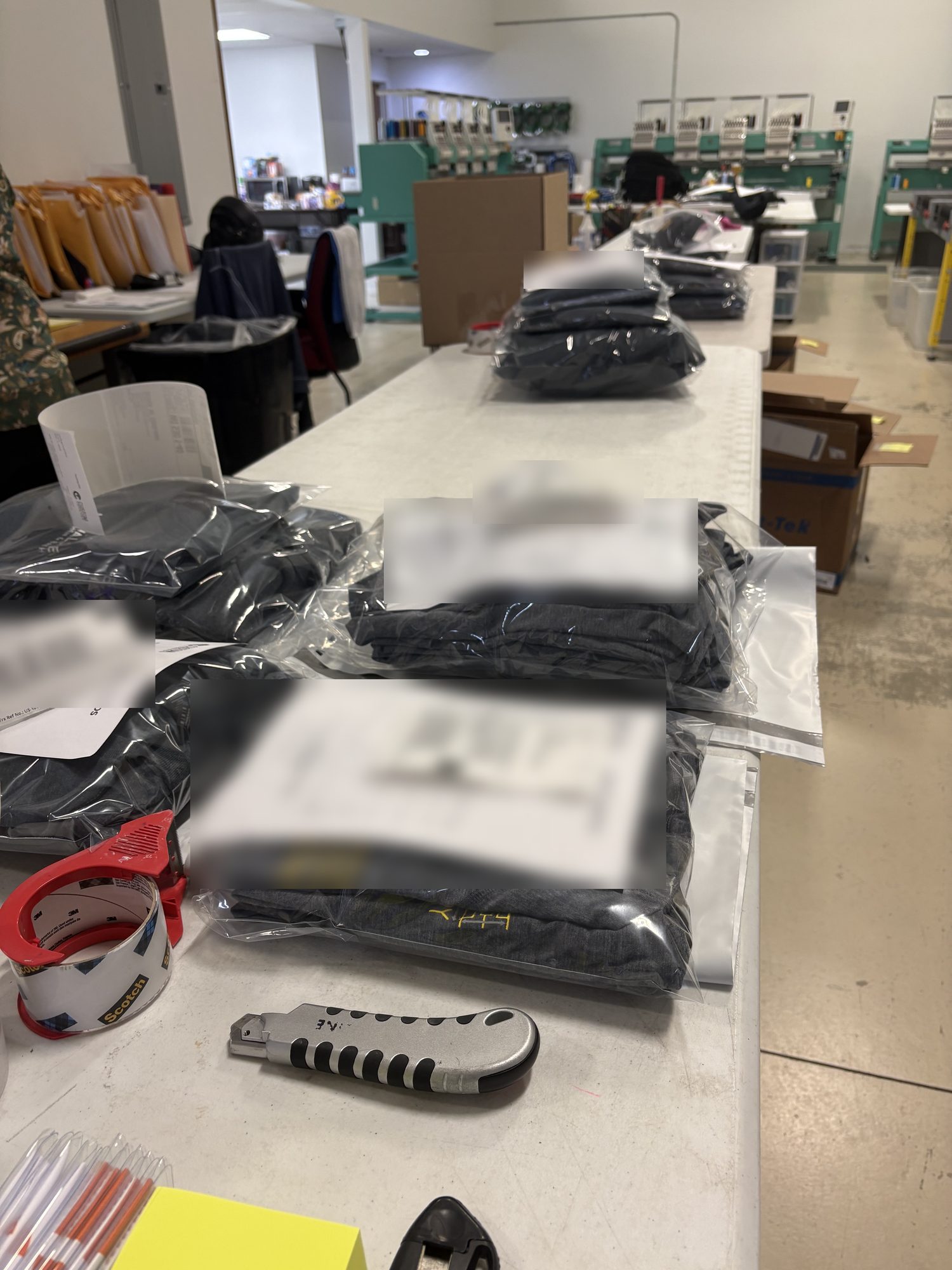
The employee contacts us directly. Not their manager, not whoever owns the program internally, and not a general inbox that routes back to your office. We support the individual wearer as our customer, which is the single most important thing to understand about how this differs from a bulk order.
That matters more than any policy wording. In a bulk model, a garment that does not fit becomes an internal problem the moment it is handed over, because the vendor’s relationship ended when the carton was delivered. Here the relationship is with the person wearing it, and it does not end at delivery. Whoever owns the program on your side is never the middleman for an order problem.
Sizes and returns
Every item lists the manufacturer’s sizing specifications. Because each item is produced for the person who ordered it and we do not stock your company’s finished apparel, we do not offer returns or exchanges on sizes ordered incorrectly. We work with your program coordinator to apply your company’s own apparel policy on incorrect sizes, and any item that does not meet our quality standards is replaced.
Reorders, Replacements and New Hires
A reorder is just an order. There is no separate process, no minimum to hit before it is worth running, and no waiting for enough other requests to accumulate into a batch. One replacement polo for one person goes through the same way a fifty piece order does, at the same price, using the same approved logo file.
That is what makes onboarding work. A new hire in March orders on their first week and is in company apparel before they have met everyone, rather than waiting until the next bulk run in October. It is also why a worn out work shirt gets replaced quietly instead of being tolerated for a year, which is a brand problem as much as a comfort one.
Where the money comes from is a separate decision, covered on employee credit and gift programs. Employees can pay, the business can fund a balance, or both.
Why Make to Order Changes the Arithmetic
Nothing is made before somebody wants it. Blanks are ordered from the wholesaler after the employee places the order, which means there is no stock sitting anywhere with your logo on it.
No inventory to write off
Nothing is bought ahead against a forecast, so nothing has to be discounted, donated or thrown out at the end of a year because headcount moved or a color was retired.
No storage, and no storage problem
There is no closet, no stockroom shelf and no pallet in the corner of a warehouse. Reclaiming that space is usually the first thing people notice.
No commitment up front
No contract, no minimum order size. The program costs what your people actually order and nothing else.
The trade is that an order is produced rather than picked off a shelf, which is why the window is 5 to 7 business days instead of same day. For an apparel program that is the right trade, and it is the one the whole six step process is built around.
Where This Fits
How individual orders are packed and shipped to each employee.
Where employees choose their own sizes from the approved portfolio.
How the ordering gets funded, and who is eligible.
The full managed program all of this sits inside.
Common Questions
The employee contacts us directly rather than going through whoever runs the program internally. Every item lists the manufacturer’s sizing specifications, so fit can be checked before ordering. Because each item is produced for the person who ordered it and we do not stock your company’s finished apparel, we do not offer returns or exchanges on sizes ordered incorrectly. We work with your program coordinator to apply your company’s own policy on incorrect sizes, and any item that does not meet our quality standards is replaced.
Us. Directly. The program coordinator inside your business is not a middleman for sizing questions, delivery problems or anything else about an individual order. That is deliberate, and it is the main practical difference from a bulk order where the vendor’s involvement ends at the loading dock.
Yes, in the same colors and with the same decoration. A program built around a single unisex cut tends to go unworn by a large part of the workforce, which is an expensive way to save a line item.
No, and that is worth knowing. Fit varies between labels, which is one of the reasons the portfolio is curated down to a considered set rather than left open to an entire catalog. Fewer labels means fewer sizing surprises across your program.
No. A single replacement polo for a single person is a normal order, at the same price, using the same approved logo file as the original. There is no batching and no waiting for a bulk run.
Within 5 to 7 business days of the order being placed. Production starts when the order comes in, because nothing is held in stock ahead of time.
Automatically. They get a receipt with an order number, a shipping notice with a tracking number, then out for delivery and delivered notifications, all sent to them directly at home.
Yes. Shipping is a line item on every order, including a single replacement item. Most companies set credit amounts with standard shipping in mind, and live shipping rates will let each employee choose between cost and delivery time.
There is none. Blanks are ordered from the wholesaler after an employee orders, so nothing is produced against a forecast and nothing has to be written off, stored or disposed of when headcount changes.
How early ordering opens is set when your program is built, and it is a common thing to specify. The point of the model is that a new starter is not waiting for the next bulk run to be in company apparel.
More on how a program runs day to day on the full FAQ page.
Ask Us the Awkward Questions
Tell us your company name, roughly how many employees you have, and what you want the program to do. Our team will follow up to talk it through.