Logo Digitizing, Embroidery and Screen Printing
Every logo in your program is digitized, stitched and printed in our own building in Michigan. There is no broker in the middle and no contract decorator who never speaks to the people wearing the apparel. One company builds the store, makes the garment, packs it and ships it.
Digitized in house
Your logo becomes a stitch file in our shop.
Sewn out before launch
Photographed for your approval.
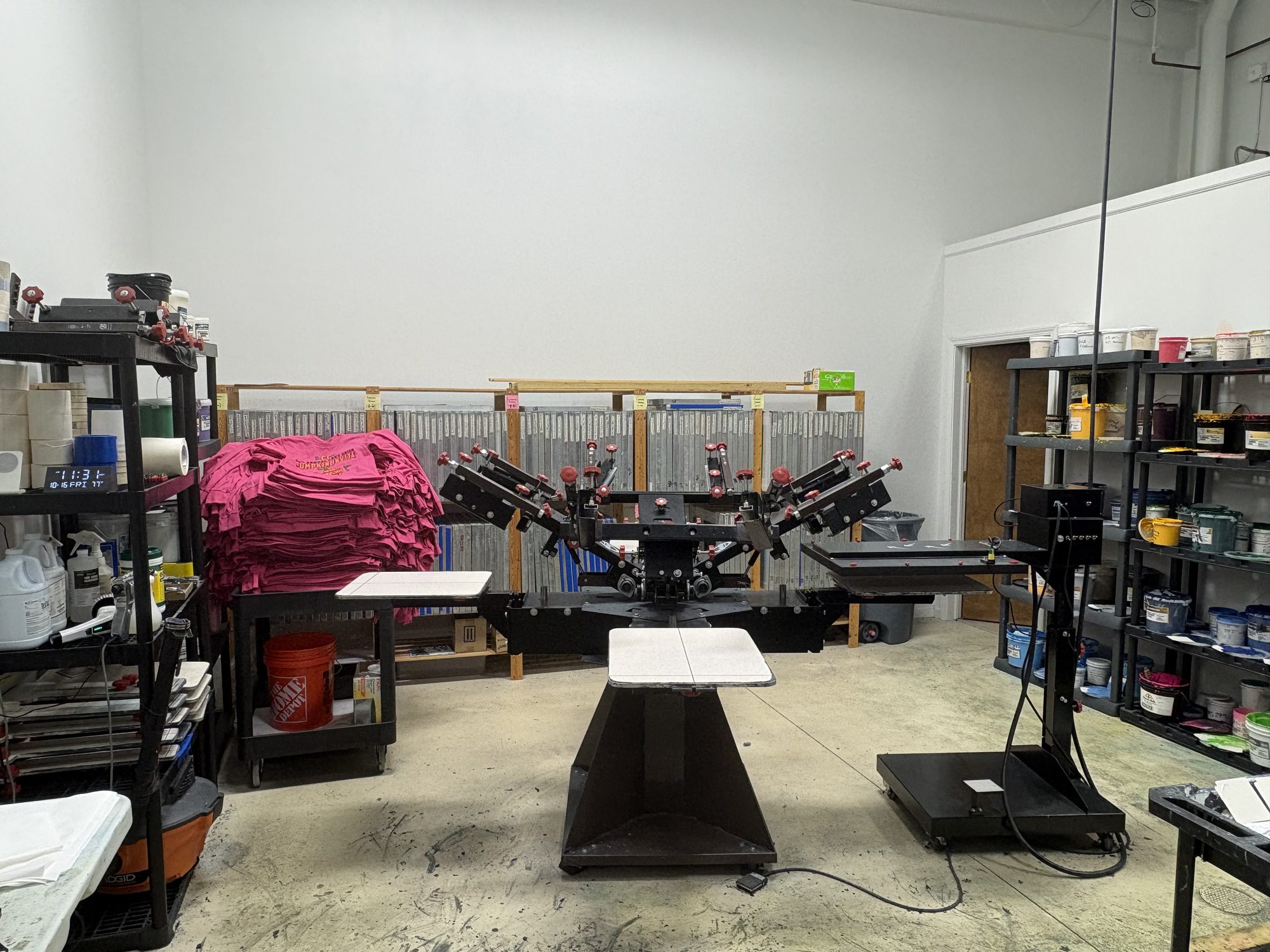
Automatic and manual presses
Volume runs and small mixed orders.
One building
Sales and production under one roof since 2003.
Where Most Apparel Programs Quietly Break
Most of this industry splits in two. On one side are resellers who outsource production, so they control neither the quality nor the delivery date of your order. On the other are contract decorators who stitch all day and never speak to a single person who wears the result. Neither one owns the whole job, so when a logo comes back the wrong blue or a sleeve sits crooked, you get two companies pointing at each other.
Custom Threads has done both halves since 2003. We run the sales relationship and we run the machines, which means the person who decides how your logo should sit on a placket is in the same building as the machine that puts it there. That is the practical reason corporate apparel management works here and falls apart elsewhere. It is also why nothing in your program waits on somebody else’s production queue.
How Your Logo Becomes a Stitch File
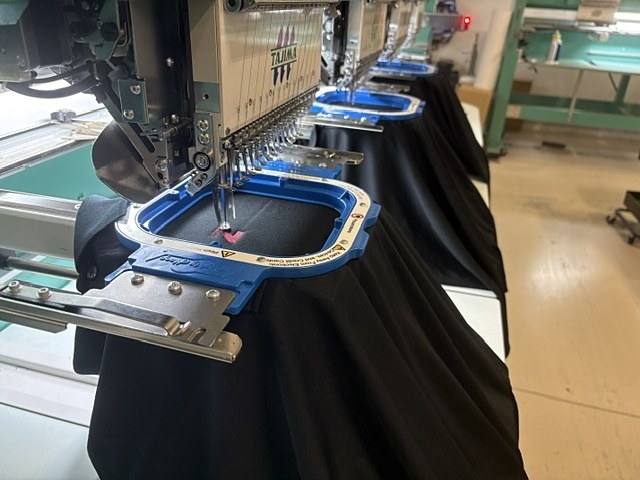
Embroidery does not read a logo file. It reads a stitch file, which is a separate thing built by hand from your artwork: every path, every direction, every change of thread. Digitizing is that translation, and it only happens once. After it is approved it runs on every order in your program from then on, which is what keeps the mark identical across a polo, a cap and a jacket that were made eighteen months apart.
01
You send the artwork
Vector art is ideal. If all you have is the logo off a business card or an old sign, send that. Rebuilding usable artwork is part of the job, not an extra step you have to solve before calling us.
02
We digitize it
Your logo is rebuilt as a stitch path. Thread colors are matched to your branding guidelines rather than to whatever is closest on the rack, and the file is built for the fabrics your program will actually use.
03
You approve the sewout
Not a screen mockup. Every embroidered logo is sewn out in house on a real garment, reworked as many times as it takes, and we send you a photo so you can see it is right. Thread on pique behaves differently from thread on a flat weave, so a logo can look right on a monitor and wrong on a chest. Complex logos may also get an actual garment sample for final sign off, and screen prints get an electronic proof.
04
It goes into your program
The approved file is attached to your store and runs on every order after that. Nobody re-sets it, nobody re-interprets it, and a reorder two years later matches the first one.
05
Second and third logos
Companies with divisions, plants or acquired brands usually carry more than one mark. Each is digitized and assigned to the right items, so a field tech and a corporate office never end up with the same chest logo by accident.
06
Changes down the road
A rebrand means re-digitizing, which we handle the same way. The old file is retired from the store so nothing ships with a mark you have stopped using.
Embroidery, and What It Goes On
Embroidery is the right call for anything a person wears in front of a customer, and for anything that needs to survive a few hundred washes without fading. It is what we put on polos, woven and dress shirts, quarter-zip and full-zip layering, coats and jackets including rainwear, baseball and knit caps, messenger and computer bags, backpacks, fitness, travel and worksite bags, soft-sided coolers, and the workwear shirts, jackets and bibs that carry a managed employee uniform program. Work pants are usually left undecorated, because a logo on a knee earns nothing and wears out first.
The garment underneath matters as much as the stitching. Your apparel brand portfolio is built to your branding guidelines first, and the decoration is matched to it, rather than a logo being dropped onto whatever blank was cheapest to buy that week.
Screen Printing, and Why We Kept the Manual Press
Screen printing carries a setup cost. Screens have to be burned, ink has to be mixed and the press has to be registered before a single shirt comes off it. That cost is the real reason most company store vendors quietly impose a minimum order on printed items, or push every printed request into a once-a-year bulk run that somebody then has to store and hand out.
We run manual equipment specifically so that is not our problem to pass on to you. An order of one polo and two tees is a routine Tuesday here. That one decision is what lets the rest of the program work the way it is sold: a store with no minimum order size, no annual bulk run, and no box of leftover shirts in a supply closet. Printing covers performance fabric shirts and sweatshirts, cotton tees and sweatshirts, safety vests and fitness pants.
Which method suits an item is a design decision as much as a production one. A polo shirt worn in front of customers reads better with a stitched mark. A team of twenty at a plant opening reads better in printed tees. Hats, caps and knit hats are almost always embroidered. Safety vests are printed, because high visibility fabric is the point and stitching through it is not. We make that call with you when the portfolio is built, so the style stays consistent across office staff, field crews and anyone wearing company uniforms.
Specialty Decoration for Gifts and Events
Two things sit outside the day-to-day store and come up often enough to be worth saying out loud. Sublimation, for trade shows and corporate events, where the art runs edge to edge and a stitched logo would not do the job. And custom knitted socks and scarves, which are made for gifting programs rather than for daily wear.
Sublimation
For trade shows and corporate events, where the art runs edge to edge.
Knitted socks and scarves
Custom knitted pieces for gifting programs.
Both normally arrive through the same door as everything else, which is an employee credit and gift program with a budget behind it, so the item ships to the individual rather than landing on your desk in a carton to be sorted and handed out.
What Doing It In House Changes for You
In house is not a quality claim on its own. Plenty of good decorators work on contract. What it changes is the number of companies between you and the garment, and it shows up everywhere from the stitch file through to corporate apparel fulfillment.
One company is accountable
Store, digitizing, production, packing and shipping are all ours. When something is wrong there is nobody to hand it to, which is the whole point.
Orders ship in 5 to 7 business days
Production starts when the employee orders, and the garment ships within 5 to 7 business days. Nothing sits in a queue behind another company’s bulk run.
A reorder of one is still an order
New hire in March needing a single polo gets the same treatment as a fifty-piece order, at the same price, with the same logo file.
Nothing is made before it is wanted
Blanks are ordered from the wholesaler after your employee places the order. There is no inventory, which means no end-of-year write-off and nothing for you to store.
The employee talks to us, not to you
We support the individual directly. Whoever owns the program internally is not the middleman for a sizing question or a delivery problem.
The look holds across every label
One standard is applied whether the garment is a consumer brand or a premium private label, so a program does not visibly split into tiers.
That last point is the part people underestimate. A program looks consistent because one shop applies one standard to every item in it, which is also what the six step process is built around.
How that plays out differs by sector, which is covered across the industries we serve.
Where This Fits
The full managed program this sits inside, from portfolio to fulfillment.
The garments the decoration goes onto, and how a portfolio gets built.
The six steps from first call to ongoing orders, with digitizing at step four.
Where your people order the decorated apparel, in their own sizes.
Common Questions
Digitizing converts your logo into a stitch file an embroidery machine can read. It is done once per logo. After you approve the sewn sample, that file runs on every order in your program from then on, so it is not something that recurs with each order. A rebrand or a genuinely new mark needs its own file.
Usually, yes. Vector artwork is the easiest starting point, but a lot of companies only have a logo off an old sign, a business card or a website. Rebuilding usable artwork from that is part of the digitizing work rather than a separate problem you need to solve before getting started.
The garment and the use decide it. Embroidery suits polos, woven shirts, outerwear, caps and bags, and anything customer-facing that has to look the same after a long run of washes. Screen printing suits performance and cotton tees and sweatshirts, safety vests and fitness pants, and anything where the art is large or needs flat coverage.
No. We run manual screen printing equipment precisely so a one-off order is routine. An order of a single polo and two tees goes through the same way a large one does, which is what allows the store to operate with no minimum order size and no annual bulk run.
That is what the approved stitch file is for. The same file is used across your program, with the sizing and placement set per item type so the mark reads correctly on a cap panel as well as on a chest. Thread colors are matched to your branding guidelines rather than chosen per order.
Yes. Digitizing and samples are step four of the process. Every embroidered logo is sewn out in house on a real garment, as many times as needed, and we send you a photo for approval. Complex logos may also get an actual garment sample for final sign off. Screen prints get an electronic proof.
Orders ship within 5 to 7 business days. Blanks are ordered from the wholesaler after the employee places the order, so nothing is made or held before it is wanted.
The program is built around garments supplied and decorated together, because that is what lets us stand behind the finished item and keep the look consistent across your whole portfolio. If you have a specific situation, raise it on the call and we will tell you honestly whether it fits.
Yes, and most companies of any size do. Divisions, plants and acquired brands each get their own digitized file, assigned to the right items in the store, so the wrong mark does not end up on the wrong group of people.
More answers on the full FAQ page, or ask us directly on a call.
Send Us Your Logo
Tell us your company name, roughly how many employees you have, and what you want decorated. Our team will follow up to talk it through.