
Corporate Apparel Management
We run branded apparel programs for companies as a managed service. Your portfolio, your online company store, your logo digitized properly, and every order produced and shipped to the individual who placed it. You keep control of how the brand looks. You stop owning the logistics.
A program, not a project
Apparel runs as an ongoing service, not a scramble each time.
Built to your guidelines
A portfolio you approve, with no catalog digging.
Decorated in house
Embroidery and screen printing in our own shop.
Ships to each employee
Packed individually, within 5 to 7 business days.
What Corporate Apparel Management Actually Means
Most companies do not have an apparel problem. They have an apparel process problem. Someone in marketing, human resources or executive administration ends up owning a job that has no owner: choosing the clothing, chasing the sizes, placing the order, checking the logo came out right, receiving a pallet, and distributing it piece by piece.
Corporate apparel management replaces that process. Instead of running a project every time apparel is needed, you run a program. The selection is built to your branding guidelines and approved by you, without anyone combing through catalogs. Each logo is digitized, sewn out in house and approved, so it reproduces correctly on every garment after that. Ordering moves to a company store your people use directly. Production happens per order, and fulfillment goes to each individual rather than to a storage room.
The practical effect is that brand consistency stops depending on whoever happens to be placing the order, and the administrative work largely disappears.
The rules themselves stay yours. If they are still being drafted, the employee dress code and apparel policy page sets out the decisions worth making before a portfolio is built, because eligibility and funding shape everything that follows.
What the Program Takes Off Your Desk
Selection and procurement
No more comparing catalogs or sourcing a new supplier each time. We curate your portfolio from what we know about brands and the items within them, you approve it, and it stays available.
Sizing and order collection
Employees order their own sizes from your store. No spreadsheet, no reply-all thread, no guessing at a distribution of sizes months in advance.
Inventory management
Make to order means there is nothing to hold. No inventory commitment, no storage, no leftover stock to discount or discard.
Distribution and logistics
Each order is packaged individually and shipped to that person’s address, nationwide and worldwide. Nobody internally becomes the mail room.
What a Managed Program Includes
These are the working parts. Each one has its own page if you want the detail.
A branded storefront built for your organization, with your approved portfolio and nothing else, so employees cannot order off-brand.
Fund the program with allowances or gift balances that employees spend in your store. Common for onboarding, service awards and incentives.
Individual packaging and direct shipping to each employee, across the United States and worldwide.
Your marks are digitized and proven out in house, and embroidery and screen printing are both done in house, which is why output stays consistent and the schedule stays ours to control.
What You Can Put in a Program
Programs are built from a portfolio chosen for your brand rather than from an open catalog, which is what keeps the look consistent. That portfolio typically spans shirts and polos, jackets and outerwear, headwear, and bags, and it can be narrowed or widened depending on what your teams actually need.
You can choose from well known consumer apparel brands or premium private label options, in both men’s and women’s fits, so the program works for everyone rather than for whoever the standard cut happens to suit.
Decoration is part of the same decision. Embroidery suits polos, woven and dress shirts, outerwear, caps and bags. Screen printing suits performance and cotton tees, sweatshirts and safety vests. For program customers, we can also take on projects outside the norm when they come up. All of it happens under our own roof, which is why one logo standard holds across every garment in the portfolio regardless of which method it needed.
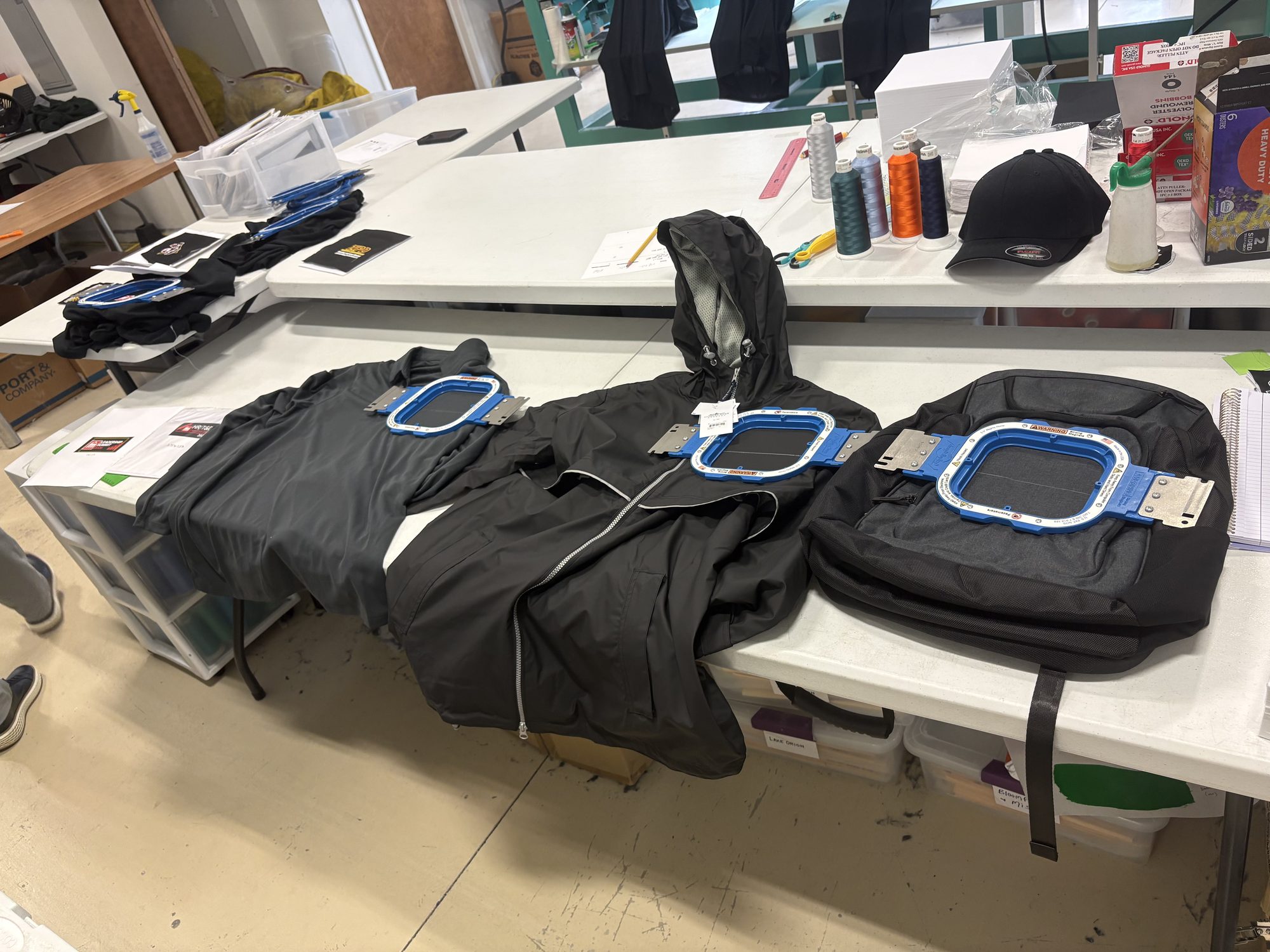
Uniforms and workwear run as a purchase program with an allowance, not a rental contract.
How a Program Gets Built
1
We talk
A Zoom call, usually about an hour, to understand your business, your people and what the program has to do, and to show you how we work.
2
Portfolio
A selection curated from your brand book and colors, approved by you, not a catalog dump.
3
Digitizing
Each logo digitized, sewn out in house and photographed for your approval, with every approved version kept on record.
4
Store launch
Your online company store goes live, usually within 2 to 4 weeks of the first call.
5
Ongoing
Orders are produced, packaged individually and shipped. The store stays open.
No Contracts, No Minimums, No Leftover Stock
No contracts
Nothing to sign and nothing to exit.
No minimums
No minimum on individual orders once a program is running.
No leftover stock
Nothing is produced until someone orders it.
Programs run make to order. Nothing is produced until someone orders it, so there is no contract, no inventory commitment, and nothing sitting unsold at the end of the year. Once a program is running there is no minimum on individual orders, and it is built for steady, ongoing business rather than one-time orders. If your headcount changes or a department’s needs shift, the program follows without renegotiating anything.
Who This Is Built For
Most of the programs we run belong to companies with at least 100 employees. Companies under 50 employees are typically not a good fit. Our manufacturing clients typically run 150 to 1,000 people, with most above 400. That is the size where branded apparel becomes a recurring obligation and still nobody has been hired to manage it.
employees, the usual starting point
employees at most manufacturing clients
to build your store
the year we started running programs
The program is usually bought by marketing, human resources or executive administration. Just as often it is inherited by a project coordinator who did not ask for it and has no budget line for the hours it takes.
Why these industries in particular. The pattern that matters is not the industry label. It is three things happening at once: more than one facility, more than one logo, and branding guidelines somebody actually enforces. A company with all three cannot solve apparel by letting each site order its own, because the mark drifts between locations and the spend disappears into departmental purchases where nobody can see it.
That combination turns up most in semiconductor equipment, robotics and automation, equipment builders, plastic materials and components, industrial distribution, lumber and forestry, and contract testing facilities. It also fits midsize accounting firms with a national footprint, large restoration and remodeling businesses, and agricultural lending banks. What those customers have in common is not what they make. It is that apparel had become somebody’s second job. The list shows where we have done the most work, not the limit of it, and fast-growing companies on their way into that size range are a good fit too.
We work with companies across the United States and ship worldwide, so being local is not a requirement. Custom Threads & Sports has been doing this since 2003.
Most of that is manufacturing and industrial work. Corporate apparel for manufacturing and industrial companies covers what changes on a plant site.
See the industries we serve, from robotics and automation to contract testing laboratories, or our corporate apparel programs in Metro Detroit if you are near our Michigan shop. If you already pay a clothing allowance, a uniform allowance program moves it into the store.
Settle this before we build
One thing worth settling before we build anything. Every store we have launched without some level of company subsidy has disappointed, whatever the headcount. When employees are asked to pay full price for branded apparel, most of them do not, and the program stalls quietly while everyone assumes it is working. It is the clearest predictor we have of whether a program succeeds, so we raise it early rather than after the store is live.
Comparing Your Options
Who makes the apparel and who supports your people.
Self-service software compared with a managed store.
Common Questions
It is the practice of running a company’s branded apparel as an ongoing managed program rather than as a series of one-off orders. A provider selects the apparel, digitizes the logo, builds an ordering system, produces each item as it is ordered, and ships it to the individual who ordered it. The company approves the brand standards and stops touching the logistics.
A promotional order ends when the box arrives, and most promotional companies outsource production, so they control neither quality nor delivery time. A managed program is continuous: the store stays open, new hires order when they start, and because we decorate everything in house, quality and timing stay under our control.
We work on many of the setup tasks at the same time. With timely information and approvals from your side, a program can be fully launched within 2 weeks, and most are live within 2 to 4 weeks of the first Zoom call.
No. There is no contract and no rental. Items are made to order and belong to the company or the employee who ordered them, and there is nothing to return or launder under an agreement.
No. Nothing is produced before it is ordered, so there is no stock to store, count or write off at the end of the year.
Each employee orders their own size from your company store, and the order ships directly to them. Nobody internally collects sizes or redistributes a bulk delivery.
That depends on how you set the program up. Many companies fund it through employee credit or gift-card balances, which is also how onboarding, service awards and incentive programs are usually handled.
If you are still weighing whether a managed program is the right move, the apparel program FAQ answers twenty-six of the questions that come up most, and the program insights blog takes on the ones that need more room than a paragraph.
Talk to Us About Your Program
Tell us your company name, roughly how many employees you have, and what you are trying to do. Our team will follow up to talk it through.