
Corporate Apparel Fulfillment
Every order produced after it is placed, packaged individually, and shipped straight to the employee who ordered it. Nationwide and worldwide. No pallet arrives at your office, and nobody on your team becomes the mail room.
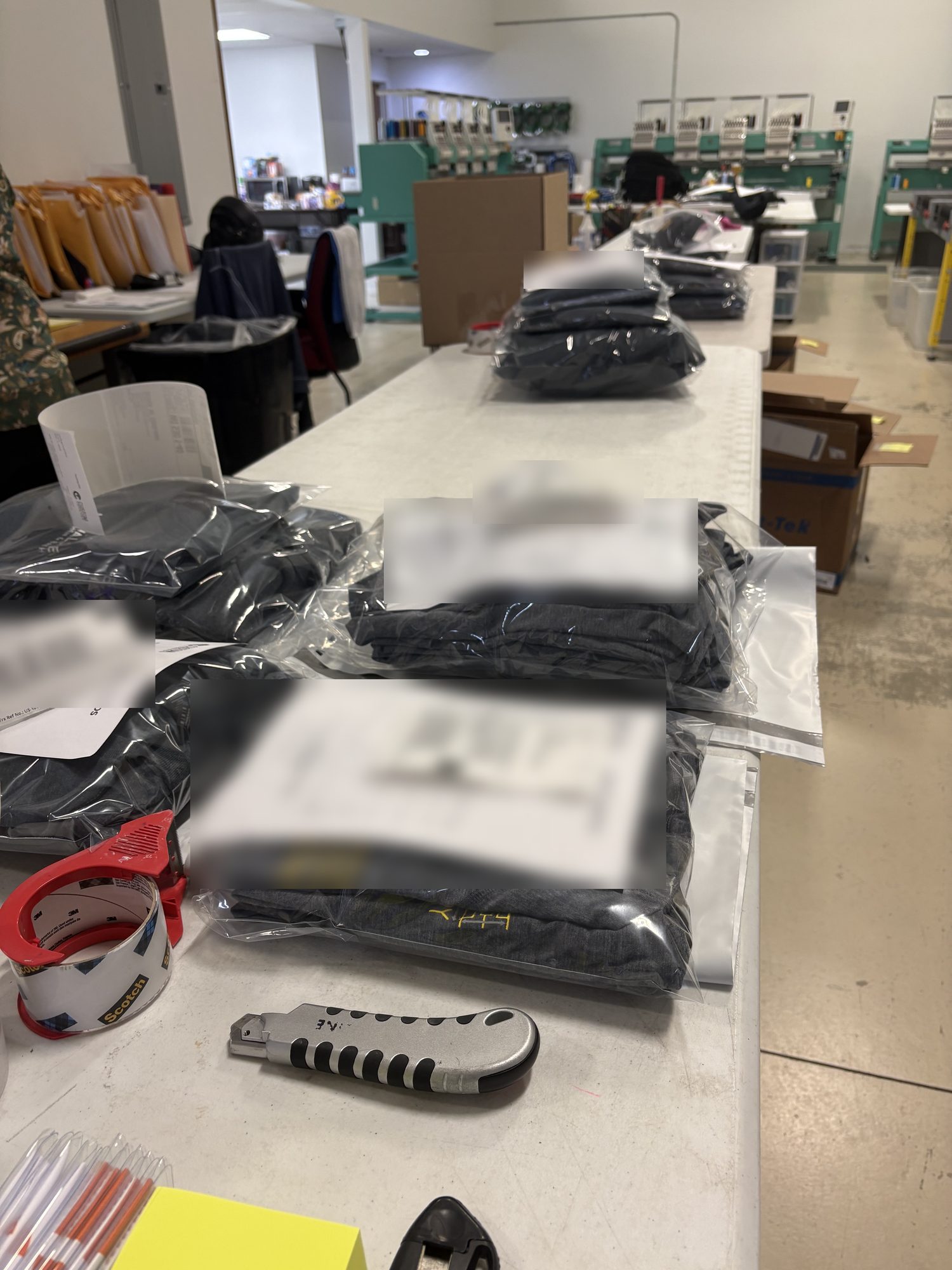
Packed one by one
Every order bagged and labeled for one person.
Ships to each employee
To the person who placed the order, nationwide and worldwide.
No bulk boxes to sort
Nothing lands at your office to hand out.
5 to 7 business days
From the order to it shipping.
What Fulfillment Means in an Apparel Program
Fulfillment is the logistics half of corporate apparel management, and it is the part most businesses underestimate. Choosing the clothing is the visible decision. Getting the right garment, in the right size, with the right brand colors, to the right person, is the work that actually consumes staff time.
In a managed program, fulfillment is not a delivery event. It is a continuous service. An employee places an order, the item is produced and decorated to your brand standards, it is packaged on its own, and it ships to that individual. The same sequence runs whether one person ordered a polo or forty people ordered jackets before a conference.
Order placed
An employee orders an item and their own size.
Produced and decorated
Made after the order, to your brand standards.
Packed on its own
Every order packaged individually.
Shipped to the person
Tracked from our shop to their door.
That is the difference between buying branded apparel and running an apparel program. One ends when the box arrives. The other keeps working.
None of this is only for the plant floor. A corporate office of several hundred people runs the same way: sales teams, office staff and executives order their polos, dress shirts, quarter zips and bags from the store, and each order ships to them. Multi-site industrial operations feel this most, because every facility would otherwise need somebody distributing. See corporate apparel for manufacturing.
The Problem With Bulk Delivery
Traditional orders arrive as one shipment addressed to your business. What happens next is rarely anyone’s actual job.
Someone becomes distribution
Cartons get opened, sorted by size and name, and handed out or re-mailed. That is hours of staff time that nobody budgeted for.
The wrong sizes surface late
A bulk order locks in a size distribution guessed months earlier. The mismatch only shows up once people start collecting their items.
Leftovers become inventory
Whatever is not claimed becomes stock. It needs somewhere to live, someone to track it, and eventually a decision about writing it off.
Remote staff get missed
Anyone not in the building has to be repackaged and reshipped individually anyway, which is the work you were trying to avoid.
None of this is the job you were handed. You were asked to get your people into apparel that looks right, not to run a distribution desk out of a spare office. Individual fulfillment takes that work off your desk and leaves you with the part worth having, which is a program everyone can see is working.
Field service companies feel every one of these at once. Restoration crew uniforms and branded workwear covers why bulk ordering breaks fastest where crews turn over constantly and garments are destroyed on the job.
How Individual Fulfillment Works
Orders ship within 5 to 7 business days, and the person who ordered is told where it is at the points that matter. Production moves quickly, so there are no separate notices while the order is being made. After the receipt, the next message is the tracking number.
What happens
What the employee is told
01
Order placed
They choose their own item and size from your online company store, from wherever they are.
Automated receipt with an order number, straight after checkout.
02
Goods ordered
We buy the blank from our wholesaler. Nothing was held here waiting.
No separate notice. This step moves quickly.
03
Decorated
The garment is decorated in house, embroidery or screen printing, to your approved brand colors and standards.
No separate notice. This step moves quickly.
04
Packed
Each order is packed on its own rather than batched into a company shipment.
No separate notice. This step moves quickly.
05
Shipped
Direct to the address that person entered, anywhere in the United States or worldwide.
An automated notice with a tracking number.
06
Delivered
To their home. Your office never handles it.
Out for delivery, then delivered.
If something is wrong, the employee contacts us directly. Sizing, returns and reorders covers exactly how that works. They do not go through your program coordinator, because taking work off that person is the reason the program exists.
What Ships, and to Whom
Programs typically cover shirts and polos, jackets and outerwear, headwear, and bags, drawn from a portfolio built to your branding guidelines rather than from an open catalog. You can choose well known consumer apparel brands or premium private label options, in both men’s and women’s fits.
Whether your organization calls them uniforms, branded apparel or company wear, the fulfillment model is the same: individual production, individual packaging, individual delivery. It suits distributed teams, multiple locations, onboarding for new employees, golf and trade events, and incentive or recognition programs, because none of those have a single delivery address that makes sense.
It also protects how your brand looks in front of customers. Consistent colors and decoration across every order matter more when the people wearing the apparel are the ones meeting your clients.
What Shipping Costs, and Who Pays for It
Shipping is its own line item on each order, priced to the address it is going to. Most companies take standard shipping into account when they set employee credit amounts, so a typical order with shipping is covered. We are moving to live shipping rates, which will let each employee compare shipping cost against delivery time and choose the option that suits them.
Programs work best when each order ships to the employee as soon as it is produced. Orders go out on time, finished orders never sit in boxes waiting to be sorted, and the person who ordered gets their own tracking number and delivery notifications. When something is wrong, they contact us rather than the person who owns your program internally.
Some companies need a different arrangement, such as orders shipped together to one location. Those can be worked out on the discovery call, but shipping directly to each employee is how you get the most value out of a program.
Make to Order Removes the Inventory Problem
Nothing is produced until someone orders it in your company store. There is no contract, no minimum on individual orders, and no leftover stock for your business to store, count or discount at the end of the year. Inventory management stops being a line item because there is no inventory.
No stock to hold
Production is triggered by the order, so nothing sits on a shelf waiting to be claimed.
No commitment up front
No contracts and no minimum on individual orders, so the program scales with headcount instead of against it.
No end-of-year write-off
Nothing goes unsold, because nothing was made speculatively in the first place.
Where Fulfillment Sits in the Program
Fulfillment is one part of a managed program. These are the others.
The full managed program: portfolio, digitizing, store, production and fulfillment together.
The branded storefront your employees order from, carrying only your approved portfolio.
Fund the program with allowances or gift balances employees spend in your store.
How a program gets built, from the first call through to launch.
When Individual Fulfillment Matters Most
Some situations make the logistics obvious. These are the ones companies most often bring to us.
Onboarding new employees
A new hire can have a credit waiting on day one, order their own size, and have it shipped to their address. No guessing their size before they accept the offer. For program clients who want a welcome package, we also offer onboarding kitting.
Golf and trade events
Event apparel has a date attached and a headcount that moves until the last week. Producing per order means late additions are a normal order rather than a second run at a different price.
Incentive and recognition programs
When apparel is a reward, it should feel like one. Individual packaging sent to the person rather than handed across a desk from a carton is a meaningful difference.
Distributed and multi-site teams
If your staff are spread across offices, sites, or home addresses, there is no central delivery point that works. Direct fulfillment is the only model that does not create internal logistics work.
Common Questions
Producing each order after it is placed, decorating it to your brand standards, packaging it individually, and shipping it to the person who ordered it. There is no bulk delivery and no internal redistribution step.
The program works best when each order ships directly to the employee as soon as it is produced: it goes out fastest, nothing sits in boxes waiting to be sorted, and the employee gets their own tracking. Other arrangements, such as orders shipped together to one location, can be worked out on the discovery call.
Shipping is a line item on each order, priced to the address it is going to. Most companies take standard shipping into account when they set employee credit amounts. We are moving to live shipping rates, which will let each employee compare shipping cost against delivery time.
Because production moves quickly. Employees get an automated receipt with an order number when they order, then a tracking number when it ships, followed by out for delivery and delivered notifications.
No. Office based companies use the same program for sales teams, office staff and executives, with polos, dress shirts, quarter zips and bags shipped to each person.
Yes. Orders ship nationwide across the United States and worldwide.
Each person selects their own size in your company store. Nobody internally collects sizes, estimates a size distribution, or ends up holding the wrong ones.
No. Because production happens per order, a new hire simply orders when they start. There is no inventory set aside waiting for someone who has not been hired yet.
Yes. Your logos are digitized and proven out, and embroidery and screen printing are both done in house, so brand colors and decoration reproduce the same way on every order rather than drifting between suppliers.
Shipping, packaging and delivery questions we are asked less often are collected on the full apparel program FAQ.
Talk to Us About Fulfillment
Tell us your company name, roughly how many employees you have, and how apparel needs to reach them. Our team will follow up to talk it through.